For years, Wissam Miqdad carried Gaza with him wherever he went.
Not only its memories, but also its fear, displacement, and exhaustion.
Like thousands of Palestinians forced to leave their homes searching for safety, Wissam says he never imagined that his family’s search for protection would lead them into another nightmare — one that unfolded while his wife was in the ninth month of pregnancy.
According to Wissam Miqdad, his family fled instability and uncertainty hoping to build a safer future. Instead, they found themselves trapped between deportation procedures, legal uncertainty, and fear of separation.
He says authorities informed him that he faced deportation while his heavily pregnant wife faced a different legal path.
Then came another devastating blow.
According to his account, he later learned that he faced deportation to Egypt, while his wife’s legal situation remained different — creating fears that the family could be separated entirely.
The questions began destroying them emotionally:
What happens when a husband is deported to Egypt while his pregnant wife remains elsewhere?
Where would their child belong?
Who protects a family already displaced by war?
Wissam says the pressure became unbearable.
After receiving devastating news regarding his legal situation, he says he suffered an emotional collapse and damaged property inside the accommodation facility.
He expected consequences.
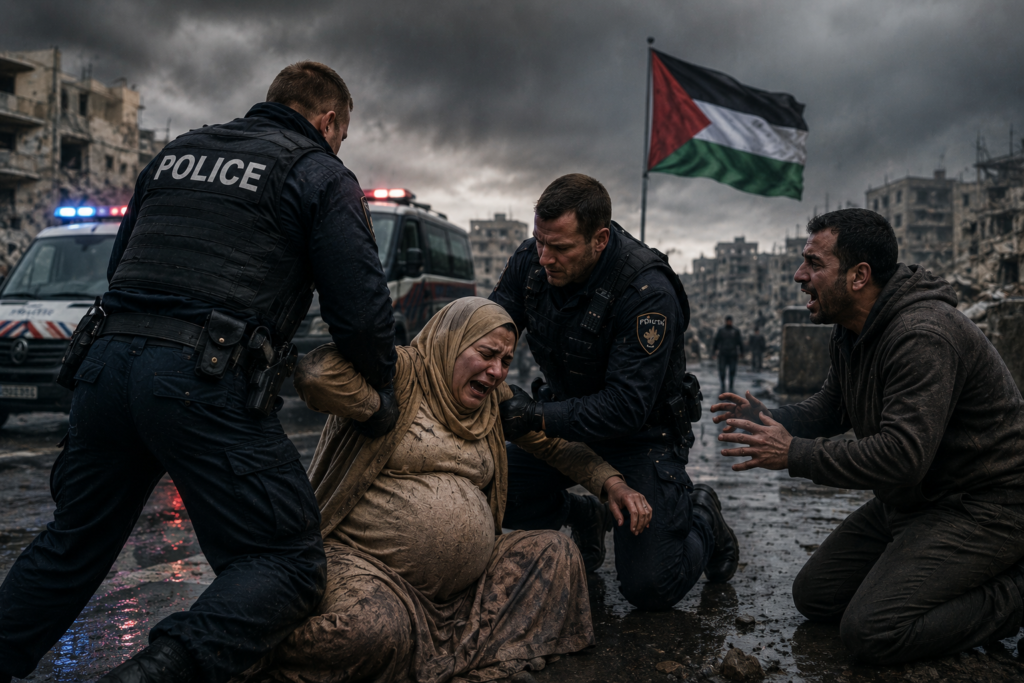
He says he did not expect police intervention while his wife was days away from giving birth.
According to Wissam, officers arrived despite knowing his wife was in the ninth month of pregnancy.
What happened next, he says, still breaks him.
Wissam said that during the intervention, his pregnant wife was dragged and subjected to violent treatment while he watched helplessly.
“She was nine months pregnant,” he says repeatedly.
“A woman carrying our child.”
For him, the deepest pain was not only fear.
It was powerlessness.
He says he watched his wife — already carrying the weight of displacement, pregnancy, and uncertainty — placed into a situation no family should experience.
As Palestinians from Gaza, Wissam says the experience left him questioning whether refugees are truly seen as human beings when they arrive carrying trauma from war.
Days later, according to his account, his wife gave birth.
He still wonders what could have happened.
What if stress had harmed the baby?
What if labor had started during the incident?
What if their story had ended differently?
Wissam spent several days in detention before appearing before a judge.
He says the court later released him while legal proceedings continue.
But freedom did not end the fear.
Months later, uncertainty still follows the family.
He says they tried contacting organizations, filing complaints, and searching for support.
According to his account, answers were limited.
Today, Wissam Miqdad says he does not want sympathy.
He wants people to understand what displacement means for Palestinians.
“People think leaving Gaza means escaping suffering,” his story suggests.
“But sometimes suffering simply changes its shape.”
For this Palestinian family, survival did not end when they crossed borders.
According to their account, it followed them there.
And for Wissam Miqdad, one fear still remains:
That after surviving war, displacement, detention, and the possibility of deportation to Egypt, his family could still lose the one thing they were searching for all along — safety.
A contributor to SARA — writing from Gaza and keeping stories by hand.

Discussion